 Add to Chrome
 Add to Firefox
 Add to Edge
QuietWalk: Physics-Informed Reinforcement Learning for Ground Reaction Force-Aware Humanoid Locomotion Under Diverse Footwear
Apr 26, 2026
Humanoid robots operating in human-centered environments (e.g., homes, hospitals, and offices) must mitigate foot--ground impact transients, as impact-induced vibration and noise degrade user experience and repeated impacts accelerate hardware wear. However, existing low-noise locomotion training often relies on kinematic proxy objectives or fragile force sensors, and footwear-induced changes in contact dynamics introduce distribution shifts that hinder policy generalization.We present QuietWalk, a physics-informed reinforcement learning framework for ground-reaction-force-aware humanoid locomotion under diverse footwear conditions. QuietWalk employs an inverse-dynamics-constrained physics-informed neural network (PINN) to estimate per-foot vertical ground reaction forces (GRFs) from proprioceptive signals, and integrates the frozen predictor into the RL training loop to penalize predicted impact forces without requiring force sensors at deployment.On a held-out real-robot dataset, enforcing inverse-dynamics consistency reduces vertical GRF prediction errors by 82%-86% compared with a purely supervised predictor and improves the coefficient of determination from 0.39/0.67 to 0.99/0.99 for the left/right feet. On hardware at 1.2 m/s (barefoot; averaged over four floor materials), QuietWalk reduces mean A-weighted noise level by 7.17 dB and peak noise level by 4.98 dB under a consistent recording setup. Cross-footwear experiments (barefoot, skate shoes, athletic sneakers, and high heels) across multiple surfaces further demonstrate robust adaptation to footwear-induced contact variations.

STRONG-VLA: Decoupled Robustness Learning for Vision-Language-Action Models under Multimodal Perturbations
Apr 14, 2026Despite their strong performance in embodied tasks, recent Vision-Language-Action (VLA) models remain highly fragile under multimodal perturbations, where visual corruption and linguistic noise jointly induce distribution shifts that degrade task-level execution. Existing robustness approaches typically rely on joint training with perturbed data, treating robustness as a static objective, which leads to conflicting optimization between robustness and task fidelity. In this work, we propose STRONG-VLA, a decoupled fine-tuning framework that explicitly separates robustness acquisition from task-aligned refinement. In Stage I, the model is exposed to a curriculum of multimodal perturbations with increasing difficulty, enabling progressive robustness learning under controlled distribution shifts. In Stage II, the model is re-aligned with clean task distributions to recover execution fidelity while preserving robustness. We further establish a comprehensive benchmark with 28 perturbation types spanning both textual and visual modalities, grounded in realistic sources of sensor noise, occlusion, and instruction corruption. Extensive experiments on the LIBERO benchmark show that STRONG-VLA consistently improves task success rates across multiple VLA architectures. On OpenVLA, our method achieves gains of up to 12.60% under seen perturbations and 7.77% under unseen perturbations. Notably, similar or larger improvements are observed on OpenVLA-OFT (+14.48% / +13.81%) and pi0 (+16.49% / +5.58%), demonstrating strong cross-architecture generalization. Real-world experiments on an AIRBOT robotic platform further validate its practical effectiveness. These results highlight the importance of decoupled optimization for multimodal robustness and establish STRONG-VLA as a simple yet principled framework for robust embodied control.
Dual-Domain Representation Alignment: Bridging 2D and 3D Vision via Geometry-Aware Architecture Search
Mar 20, 2026Modern computer vision requires balancing predictive accuracy with real-time efficiency, yet the high inference cost of large vision models (LVMs) limits deployment on resource-constrained edge devices. Although Evolutionary Neural Architecture Search (ENAS) is well suited for multi-objective optimization, its practical use is hindered by two issues: expensive candidate evaluation and ranking inconsistency among subnetworks. To address them, we propose EvoNAS, an efficient distributed framework for multi-objective evolutionary architecture search. We build a hybrid supernet that integrates Vision State Space and Vision Transformer (VSS-ViT) modules, and optimize it with a Cross-Architecture Dual-Domain Knowledge Distillation (CA-DDKD) strategy. By coupling the computational efficiency of VSS blocks with the semantic expressiveness of ViT modules, CA-DDKD improves the representational capacity of the shared supernet and enhances ranking consistency, enabling reliable fitness estimation during evolution without extra fine-tuning. To reduce the cost of large-scale validation, we further introduce a Distributed Multi-Model Parallel Evaluation (DMMPE) framework based on GPU resource pooling and asynchronous scheduling. Compared with conventional data-parallel evaluation, DMMPE improves efficiency by over 70% through concurrent multi-GPU, multi-model execution. Experiments on COCO, ADE20K, KITTI, and NYU-Depth v2 show that the searched architectures, termed EvoNets, consistently achieve Pareto-optimal trade-offs between accuracy and efficiency. Compared with representative CNN-, ViT-, and Mamba-based models, EvoNets deliver lower inference latency and higher throughput under strict computational budgets while maintaining strong generalization on downstream tasks such as novel view synthesis. Code is available at https://github.com/EMI-Group/evonas
Biomechanical Comparisons Reveal Divergence of Human and Humanoid Gaits
Feb 25, 2026It remains challenging to achieve human-like locomotion in legged robots due to fundamental discrepancies between biological and mechanical structures. Although imitation learning has emerged as a promising approach for generating natural robotic movements, simply replicating joint angle trajectories fails to capture the underlying principles of human motion. This study proposes a Gait Divergence Analysis Framework (GDAF), a unified biomechanical evaluation framework that systematically quantifies kinematic and kinetic discrepancies between humans and bipedal robots. We apply GDAF to systematically compare human and humanoid locomotion across 28 walking speeds. To enable reproducible analysis, we collect and release a speed-continuous humanoid locomotion dataset from a state-of-the-art humanoid controller. We further provide an open-source implementation of GDAF, including analysis, visualization, and MuJoCo-based tools, enabling quantitative, interpretable, and reproducible biomechanical analysis of humanoid locomotion. Results demonstrate that despite visually human-like motion generated by modern humanoid controllers, significant biomechanical divergence persists across speeds. Robots exhibit systematic deviations in gait symmetry, energy distribution, and joint coordination, indicating that substantial room remains for improving the biomechanical fidelity and energetic efficiency of humanoid locomotion. This work provides a quantitative benchmark for evaluating humanoid locomotion and offers data and versatile tools to support the development of more human-like and energetically efficient locomotion controllers. The data and code will be made publicly available upon acceptance of the paper.
IRIS: Implicit Reward-Guided Internal Sifting for Mitigating Multimodal Hallucination
Feb 03, 2026Hallucination remains a fundamental challenge for Multimodal Large Language Models (MLLMs). While Direct Preference Optimization (DPO) is a key alignment framework, existing approaches often rely heavily on costly external evaluators for scoring or rewriting, incurring off-policy learnability gaps and discretization loss. Due to the lack of access to internal states, such feedback overlooks the fine-grained conflicts between different modalities that lead to hallucinations during generation. To address this issue, we propose IRIS (Implicit Reward-Guided Internal Sifting), which leverages continuous implicit rewards in the native log-probability space to preserve full information density and capture internal modal competition. This on-policy paradigm eliminates learnability gaps by utilizing self-generated preference pairs. By sifting these pairs based on multimodal implicit rewards, IRIS ensures that optimization is driven by signals that directly resolve modal conflicts. Extensive experiments demonstrate that IRIS achieves highly competitive performance on key hallucination benchmarks using only 5.7k samples, without requiring any external feedback during preference alignment. These results confirm that IRIS provides an efficient and principled paradigm for mitigating MLLM hallucinations.
Scaling Behaviors of Evolutionary Algorithms on GPUs: When Does Parallelism Pay Off?
Jan 27, 2026Evolutionary algorithms (EAs) are increasingly implemented on graphics processing units (GPUs) to leverage parallel processing capabilities for enhanced efficiency. However, existing studies largely emphasize the raw speedup obtained by porting individual algorithms from CPUs to GPUs. Consequently, these studies offer limited insight into when and why GPU parallelism fundamentally benefits EAs. To address this gap, we investigate how GPU parallelism alters the behavior of EAs beyond simple acceleration metrics. We conduct a systematic empirical study of 16 representative EAs on 30 benchmark problems. Specifically, we compare CPU and GPU executions across a wide range of problem dimensionalities and population sizes. Our results reveal that the impact of GPU acceleration is highly heterogeneous and depends strongly on algorithmic structure. We further demonstrate that conventional fixed-budget evaluation based on the number of function evaluations (FEs) is inadequate for GPU execution. In contrast, fixed-time evaluation uncovers performance characteristics that are unobservable under small or practically constrained FE budgets, particularly for adaptive and exploration-oriented algorithms. Moreover, we identify distinct scaling regimes in which GPU parallelism is beneficial, saturates, or degrades as problem dimensionality and population size increase. Crucially, we show that large populations enabled by GPUs not only improve hardware utilization but also reveal algorithm-specific convergence and diversity dynamics that are difficult to observe under CPU-constrained settings. Consequently, our findings indicate that GPU parallelism is not strictly an implementation detail, but a pivotal factor that influences how EAs should be evaluated, compared, and designed for modern computing platforms.
Overlooked Safety Vulnerability in LLMs: Malicious Intelligent Optimization Algorithm Request and its Jailbreak
Jan 01, 2026The widespread deployment of large language models (LLMs) has raised growing concerns about their misuse risks and associated safety issues. While prior studies have examined the safety of LLMs in general usage, code generation, and agent-based applications, their vulnerabilities in automated algorithm design remain underexplored. To fill this gap, this study investigates this overlooked safety vulnerability, with a particular focus on intelligent optimization algorithm design, given its prevalent use in complex decision-making scenarios. We introduce MalOptBench, a benchmark consisting of 60 malicious optimization algorithm requests, and propose MOBjailbreak, a jailbreak method tailored for this scenario. Through extensive evaluation of 13 mainstream LLMs including the latest GPT-5 and DeepSeek-V3.1, we reveal that most models remain highly susceptible to such attacks, with an average attack success rate of 83.59% and an average harmfulness score of 4.28 out of 5 on original harmful prompts, and near-complete failure under MOBjailbreak. Furthermore, we assess state-of-the-art plug-and-play defenses that can be applied to closed-source models, and find that they are only marginally effective against MOBjailbreak and prone to exaggerated safety behaviors. These findings highlight the urgent need for stronger alignment techniques to safeguard LLMs against misuse in algorithm design.
Self-motion as a structural prior for coherent and robust formation of cognitive maps
Dec 23, 2025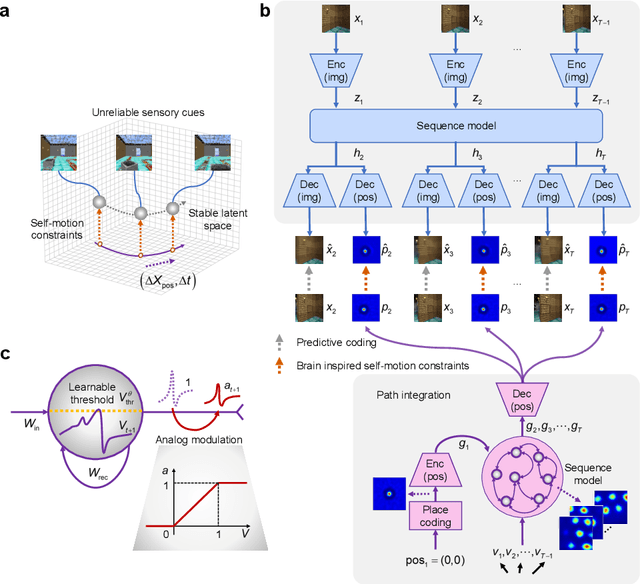
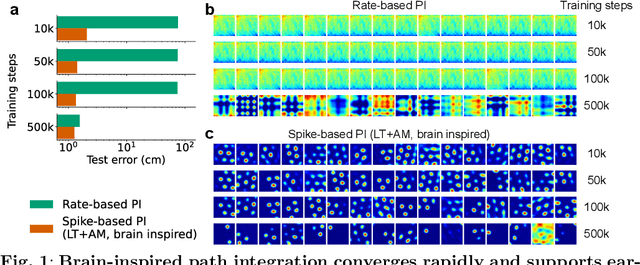
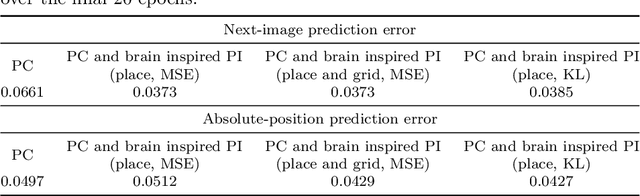
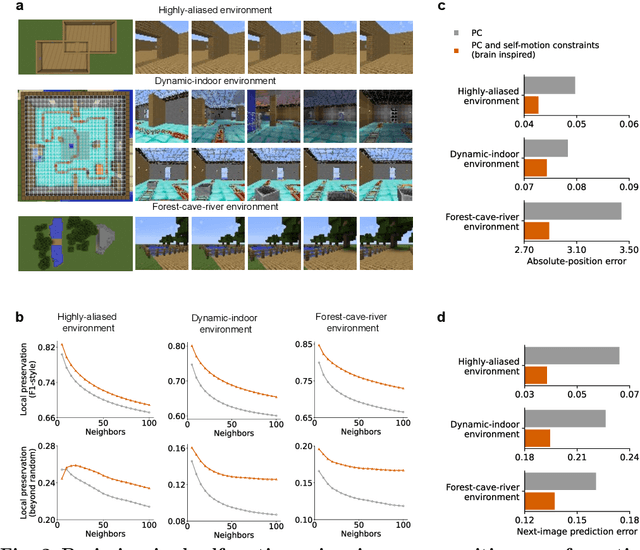
Most computational accounts of cognitive maps assume that stability is achieved primarily through sensory anchoring, with self-motion contributing to incremental positional updates only. However, biological spatial representations often remain coherent even when sensory cues degrade or conflict, suggesting that self-motion may play a deeper organizational role. Here, we show that self-motion can act as a structural prior that actively organizes the geometry of learned cognitive maps. We embed a path-integration-based motion prior in a predictive-coding framework, implemented using a capacity-efficient, brain-inspired recurrent mechanism combining spiking dynamics, analog modulation and adaptive thresholds. Across highly aliased, dynamically changing and naturalistic environments, this structural prior consistently stabilizes map formation, improving local topological fidelity, global positional accuracy and next-step prediction under sensory ambiguity. Mechanistic analyses reveal that the motion prior itself encodes geometrically precise trajectories under tight constraints of internal states and generalizes zero-shot to unseen environments, outperforming simpler motion-based constraints. Finally, deployment on a quadrupedal robot demonstrates that motion-derived structural priors enhance online landmark-based navigation under real-world sensory variability. Together, these results reframe self-motion as an organizing scaffold for coherent spatial representations, showing how brain-inspired principles can systematically strengthen spatial intelligence in embodied artificial agents.
OmniMER: Indonesian Multimodal Emotion Recognition via Auxiliary-Enhanced LLM Adaptation
Dec 22, 2025Indonesian, spoken by over 200 million people, remains underserved in multimodal emotion recognition research despite its dominant presence on Southeast Asian social media platforms. We introduce IndoMER, the first multimodal emotion recognition benchmark for Indonesian, comprising 1,944 video segments from 203 speakers with temporally aligned text, audio, and visual annotations across seven emotion categories. The dataset exhibits realistic challenges including cross-modal inconsistency and long-tailed class distributions shaped by Indonesian cultural communication norms. To address these challenges, we propose OmniMER, a multimodal adaptation framework built upon Qwen2.5-Omni that enhances emotion recognition through three auxiliary modality-specific perception tasks: emotion keyword extraction for text, facial expression analysis for video, and prosody analysis for audio. These auxiliary tasks help the model identify emotion-relevant cues in each modality before fusion, reducing reliance on spurious correlations in low-resource settings. Experiments on IndoMER show that OmniMER achieves 0.582 Macro-F1 on sentiment classification and 0.454 on emotion recognition, outperforming the base model by 7.6 and 22.1 absolute points respectively. Cross-lingual evaluation on the Chinese CH-SIMS dataset further demonstrates the generalizability of the proposed framework. The dataset and code are publicly available. https://github.com/yanxm01/INDOMER
LacaDM: A Latent Causal Diffusion Model for Multiobjective Reinforcement Learning
Dec 22, 2025Multiobjective reinforcement learning (MORL) poses significant challenges due to the inherent conflicts between objectives and the difficulty of adapting to dynamic environments. Traditional methods often struggle to generalize effectively, particularly in large and complex state-action spaces. To address these limitations, we introduce the Latent Causal Diffusion Model (LacaDM), a novel approach designed to enhance the adaptability of MORL in discrete and continuous environments. Unlike existing methods that primarily address conflicts between objectives, LacaDM learns latent temporal causal relationships between environmental states and policies, enabling efficient knowledge transfer across diverse MORL scenarios. By embedding these causal structures within a diffusion model-based framework, LacaDM achieves a balance between conflicting objectives while maintaining strong generalization capabilities in previously unseen environments. Empirical evaluations on various tasks from the MOGymnasium framework demonstrate that LacaDM consistently outperforms the state-of-art baselines in terms of hypervolume, sparsity, and expected utility maximization, showcasing its effectiveness in complex multiobjective tasks.